How Readable English Aligns with the Science of Reading
The Science of Reading has reshaped how we approach literacy instruction, providing evidence-based guidelines for effective reading programs....
K-12Discover how Readable English is transforming reading instruction |
PROGRESS MONITORINGEasily assess and monitor growth with data-driven insights and reporting tools |
PROFESSIONAL SERVICESDiscover the services that support your success, from virtual training to expert coaching |
INDIVIDUALSStrengthen your reading skills with an interactive app tailored to your learning needs |
PARENTSEmpower your child's reading journey with an interactive app and expert strategies for home support |
|
|
Rethinking Reading: How One District Transformed Instruction (SmartBrief)Discover how a bold shift in reading instruction helped struggling learners thrive - and the critical role Readable English played in their success.
|
RESEARCH & RESULTSExplore peer-reviewed studies and real-world case studies on Readable English in action |
BLOGExplore articles on feature highlights, research deep-dives, and the latest literacy insights |
EBOOKDownload the ebook Why Learning to Read English is So Hard and how to Make it Easier |
CUSTOMER STORIESDiscover how educators and administrators are transforming literacy with Readable English |
RESOURCE AND PRODUCT ENABLEMENT LIBRARYFind essential educational references and instructional materials to enhance teaching |
FAQSFind essential educational references and instructional materials to enhance teaching |
NEWS & EVENTSStay up to date with media coverage, webinars, and upcoming events featuring Readable English |
|
|
Rethinking Reading: How One District Transformed Instruction (SmartBrief)Discover how a bold shift in reading instruction helped struggling learners thrive - and the critical role Readable English played in their success. |
Vocabulary is one of the strongest predictors of reading comprehension, yet it is often assumed students will “pick it up” naturally. While exposure to language does matter, decades of research show that intentional, systematic vocabulary instruction is essential for supporting comprehension, fluency, and expressive language, especially for students who struggle with reading.
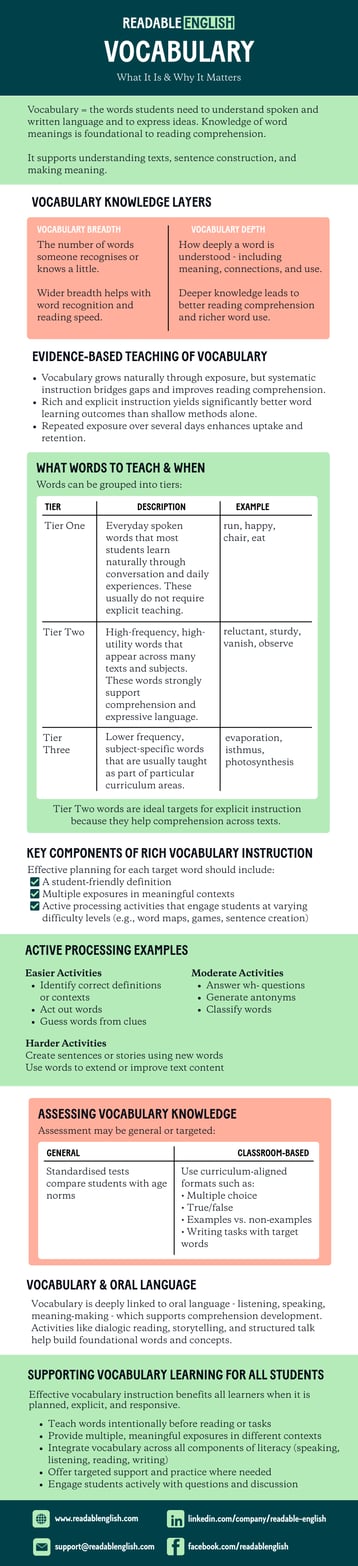
Our new vocabulary infographic highlights the key principles educators need to understand to teach vocabulary effectively. Below, we unpack the ideas behind the visual and explain how to apply them in the classroom
Download the Vocabulary Infographic as PDF

Vocabulary refers to the words students must understand to make sense of spoken and written language and to express their ideas clearly. Knowledge of word meanings is foundational to:
Reading comprehension
Sentence construction
Academic language development
Oral language and writing
Students cannot comprehend texts if too many words are unfamiliar. Simply put, word knowledge drives meaning.
Effective vocabulary instruction develops both:
Vocabulary breadth: the number of words a student recognizes or knows at a basic level
Vocabulary depth: how well a student understands a word, including its meaning, relationships, nuances, and correct usage
Breadth supports word recognition and reading speed, while depth supports comprehension and rich language use. Strong readers need both.
Although vocabulary grows through exposure, research consistently shows that explicit and systematic instruction leads to significantly better outcomes. Effective instruction includes:
Direct teaching of word meanings
Multiple exposures across days and contexts
Active processing opportunities
Integration with reading, writing, speaking, and listening
When vocabulary instruction is intentional, students are more likely to retain and apply new words.
Vocabulary is often grouped into three tiers:
Tier One
Everday spoken words learned naturally through conversation (e.g., run, happy, chair). These usually do not require explicit instruction.
Tier Two
High-frequency, high-utility words that appear across many texts and subjects (e.g., reluctant, observe, vanish). These are the most powerful targets for instruction because they strongly support comprehension and expressive language.
Tier Three
Low-frequency, subject-specific terms (e.g., photosynthesis, isthmus), typically taught as part of content instruction.
For each target word, instruction should include:
a clear, student-friendly definition
Multiple meaningful exposures
Active processing tasks at varying levels of difficulty (e.g., word maps, games, sentence creation)
This combination supports both understanding and long-term retention.
Students deepen vocabulary knowledge when they use words, not just hear definitions. Examples include:
Easier tasks: identifying correct definitions, acting out words, guessing from context
Moderate tasks: answering “wh-” questions, generating antonyms, classifying words
Harder tasks: writing sentences or stories, using words to extend or revise text
The more cognitively engaged students are, the stronger their word learning becomes.
Vocabulary can be assessed in different ways:
General assessments (e.g., standardized tests) compare students to norms
Classroom-based assessments align with instruction and include multiple choice, true/false, examples vs. non-examples, and writing tasks
Targeted assessment helps educators determine not just if students recognize a word, but whether they truly understand and can use it.
Vocabulary is deeply connected to oral language development. Activities such as dialogic reading, storytelling, and structured discussion build word knowledge while strengthening listening, speaking, and meaning-making skills.
Effective vocabulary instruction benefits all learners when it is:
Planned and explicit
Integrated across literacy components
Repeated across contexts
Responsive to individual student needs
Teaching vocabulary intentionally before reading and revisiting words often helps close gaps and strengthen comprehension for every student.
Vocabulary is not an “extra” - it is central to literacy success. With thoughtful instruction and purposeful word selection, educators can dramatically improve students’ ability to understand texts and express ideas with confidence.
We’re rethinking what’s possible for reading instruction. With Readable English, teaching is grounded in clear, evidence-based practice so every student can learn with confidence and success.
Explore our resources or contact us to schedule a demo today!
The Science of Reading has reshaped how we approach literacy instruction, providing evidence-based guidelines for effective reading programs....
Reading is a complex skill, and if you stop to think about how many words an average adult reader can recognize - anywhere from 30,000 to 70,000 -...
Effective reading instruction is built on five essential pillars. These key reading skills are supported by decades of research and are the...