.png?width=350&height=60&name=Readable%20English%20Logo%20(1).png "Readable English")
.png?width=35&height=350&name=Divider%20Line%20(2).png)


 Anna Boyle
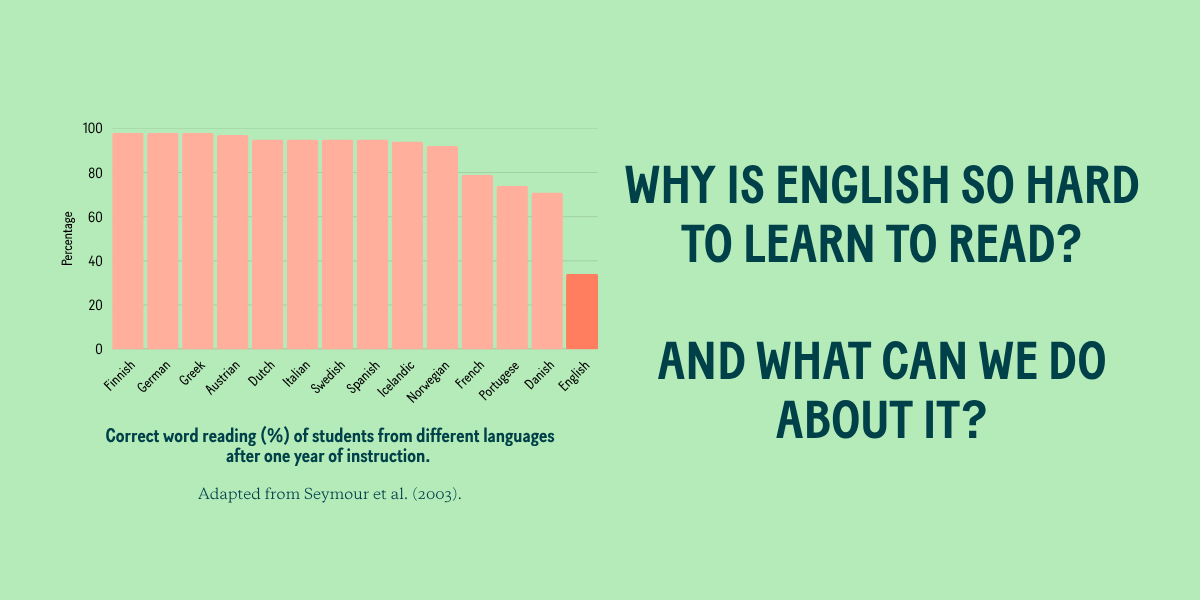
Why Is English So Hard to Learn to Read? And What Can We Do About It?
 Anna Boyle : Jun 29, 2026
Imagine asking a child to read these words:
Career and Technical Education (CTE) is undergoing a massive renaissance. Across the country, high schools and vocational centers are providing students with incredible, direct pathways to high-paying, high-demand careers in automotive engineering, healthcare, cybersecurity, construction, and aviation.
For students who have historically struggled in traditional, lecture-heavy academic classrooms, CTE feels like a lifeline. It is hands-on. It is practical. It allows them to prove their intelligence through spatial logic, problem-solving, and tactile mastery.
But as these students advance into specialized programs, they frequently hit an invisible, devastating wall.
It’s not a lack of passion. It’s not a lack of work ethic.
It is the vocabulary.
When a struggling reader enters high school, the gap between their decoding skills and their grade-level curriculum widens exponentially. In a standard English class, they might rely on context clues or audiobooks to get by.
But in a CTE pathway, the linguistic demands change completely. Suddenly, students are expected to read, comprehend, and master highly specialized, multisyllabic jargon.
Consider what a student faces across different fields:
Health Sciences: Cardiovascular, subcutaneous, epidemiological, sphingolipid.
Automotive Technology: Microprocessor, solenoid, synchronization, multi-link suspension.
Information Technology: Cryptographic, authentication, virtualization, asynchronous.
These aren’t everyday words. They are dense, multi-morphemic linguistic codes. For a student reading at a 3rd or 4th-grade level, encountering a word like “epidemiological” or “cryptographic” on a page causes immediate cognitive overload. They cannot sound it out using basic phonics, they cannot guess it from a picture, and the spelling patterns don't follow the rules they were taught in elementary school.
The Real-World Cost of the Decoding Barrier
The tragedy of the literacy gap in CTE is that a student can be an absolute genius under the hood of a car or brilliant at setting up a secure computer network, but if they cannot pass the written certification exam, they cannot enter the field.
To earn a professional credential (like an ASE certification in automotive, a CompTIA security license, or a Certified Nursing Assistant designation), students must pass rigorous, text-heavy assessments.
When a student fails these exams, it rarely means they didn’t understand the physical concepts. It usually means the vocabulary stood between them and their career goals. Traditional intervention methods tell us to pull these students out of their elective blocks for intensive phonics tutoring. But pulling a 16-year-old out of the welding lab or the nursing simulation room to look at elementary flashcards is a logistical and emotional failure. It damages their confidence and robs them of the very classes that keep them engaged in school.
At Readable English, we believe that a student's career potential should never be limited by an inconsistent language code. You cannot close the skills gap without closing the reading gap.
Instead of asking CTE instructors to pause their technical lessons to teach foundational reading rules, or forcing older students back into elementary intervention, we change the text itself.
By utilizing the Readable English digital conversion tools and mobile app, complex technical curriculum becomes instantly accessible:
Immediate Syllabication: Intimidating multisyllabic words are automatically broken down into manageable chunks, allowing students to systematically decode them.
Visual Phonetic Markups: Silent letters are grayed out and our patented glyphs instantly reveal the exact sound of every letter. The guesswork is eliminated in real time.
Morphological Logic: Because the app breaks down words into roots, prefixes, and suffixes, students don't just learn how to pronounce words like “subcutaneous”—they learn how to dissect their meaning (sub- meaning under, cutan- meaning skin).
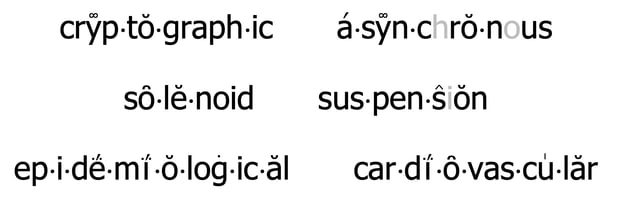
When we give CTE students a "tutor in their pocket," we aren't just helping them read a textbook. We are giving them the operating system they need to unlock technical manuals, pass state certification exams, and step into high-paying careers with total confidence.
We need to stop viewing literacy as a problem that belongs solely to the English department. Literacy is an economic imperative, and it is the ultimate foundation of workforce readiness.
Let's ensure that every student who has the passion and talent to build, heal, or secure our world has the tools to read it, too.
Want to learn more about Readable English? Explore our resources page or contact us to see how we can help your students achieve reading success.
Anna Boyle : Jun 29, 2026
Imagine asking a child to read these words:
Anna Boyle : May 7, 2026
If your child is 10 years old and still struggling to read, it’s natural to ask: “What’s wrong?” But that might be the wrong question. A better...

 Tammy Miller : Oct 17, 2023
There's more to reading than just phonics and how to partner with Readable English to bring effective reading intervention to students. The secret...