K-12

Discover how Readable English is transforming reading instruction 

PROGRESS MONITORING

Easily assess and monitor growth with data-driven insights and reporting tools

PROFESSIONAL SERVICES

Discover the services that support your success, from virtual training to expert coaching

INDIVIDUALS

Strengthen your reading skills with an interactive app tailored to your learning needs

PARENTS

Empower your child's reading journey with an interactive app and expert strategies for home support

Divider Line (2)


students raising hand in class


Rethinking Reading: How One District Transformed Instruction (SmartBrief)


Discover how a bold shift in reading instruction helped struggling learners thrive - and the critical role Readable English played in their success.


Read now  Arrow Icon - Read Boosting Middle School Literacy: How Readable English is Making a Difference in the Classroom


RESEARCH & RESULTS

Explore peer-reviewed studies and real-world case studies on Readable English in action

BLOG

Explore articles on feature highlights, research deep-dives, and the latest literacy insights 

EBOOK

Download the ebook Why Learning to Read English is So Hard and how to Make it Easier

CUSTOMER STORIES

Discover how educators and administrators are transforming literacy with Readable English 


RESOURCE AND PRODUCT ENABLEMENT LIBRARY

Find essential educational references and instructional materials to enhance teaching

FAQS

Find essential educational references and instructional materials to enhance teaching

NEWS & EVENTS

Stay up to date with media coverage, webinars, and upcoming events featuring Readable English

Divider Line (2)


students raising hand in class


Rethinking Reading: How One District Transformed Instruction (SmartBrief)


Discover how a bold shift in reading instruction helped struggling learners thrive - and the critical role Readable English played in their success. 


Read now  Arrow Icon - Read Boosting Middle School Literacy: How Readable English is Making a Difference in the Classroom


3 min read

Why Can't My 10 Year Old Read?

If your child is 10 years old and still struggling to read, it’s natural to ask:

“What’s wrong?”

But that might be the wrong question.

A better question is:

“What is making reading so difficult?”

Because for many children, the problem isn’t motivation, intelligence, or effort.

It’s the system they’re trying to learn.

The Uncomfortable Truth: English Is a Difficult Code

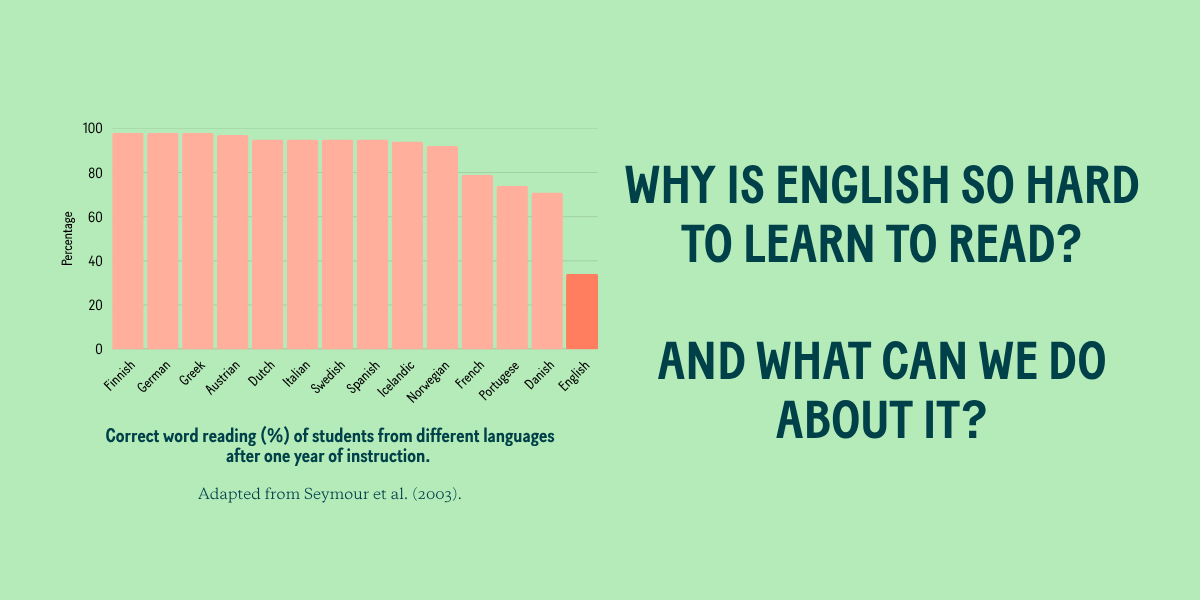
English is not an easy language to read. In fact, it is one of the most complex alphabetic writing systems in the world.

In a simple alphabetic system:

  • One sound = one spelling

  • One spelling = one sound

But English does not work like that.

Instead, it is a many-to-many system:

  • One sound can be spelled many ways
    /ee/ → ee, ea, ie, e, ey, ei

  • One spelling can represent many sounds
    “ou” in house, soup, could, cough, rough, dough

This creates constant ambiguity.

As children progress, they encounter:

  • silent letters (onomatopoeia, subtle)

  • complex syllabic structures (anemone, deity)

  • inconsistent phonological and morphological patterns (speak → speech, courage → courageous)

At this point, straightforward segmentation (reading a word letter-by-letter) becomes harder to rely on as a complete system.

And that creates pressure on how reading is taught.

A Long-Standing Debate (And Why It Keeps Repeating)

This is where the historical cycle in reading instruction begins to make sense.

Why do approaches like balanced literacy and whole language keep reappearing?

Because English does not consistently support a purely phonics-driven model at scale.

This debate is not new. It goes back decades, including work such as Why Johnny Can’t Read, and later figures such as Lucy Calkins.

As children encounter more complex vocabulary, the limitations of straightforward phonics rules become more visible. When simple decoding feels insufficient, instructional systems naturally move toward meaning-based support.

This is why approaches such as whole language, balanced literacy, and three-cueing / MS keep re-emerging over time.

They are attempts to solve a real problem: how to help children make sense of print when the code itself is inconsistent.

Yes, Structured Phonics Works — But It’s Demanding

This is not to suggest that English cannot be taught explicitly.

It can.

Structured phonics approaches—including Orton-Gillingham and other structured literacy programs—are designed to do exactly that. They teach:

  • grapheme–phoneme correspondences

  • spelling patterns

  • morphological structure

  • rules and exceptions

And they are effective.

However, they come with trade-offs:

  • highly time-intensive

  • require specialist training

  • demand sustained cognitive effort over many years

For many learners, especially those who struggle with working memory for spelling patterns or pattern recognition, the learning curve is steep and ongoing.

Structured phonics is the most systematic way to teach English reading—but it is also a heavy instructional lift.

So… Is It the Child or the System?

For a long time, reading difficulties were framed as a problem within the child.

But there is another way to see it:

Maybe we are asking children to master a system that is unnecessarily difficult.

English spelling was not carefully designed. It evolved over time through:

  • borrowing from multiple languages

  • preserving historical spellings

  • accumulating inconsistencies

The result is a system that places a heavy burden on learners—especially those who do not naturally pick up patterns easily.

Why Some Children Fall Behind (Even With Good Teaching)

Even with strong instruction, some children still struggle because:

  • they find it harder to remember spelling patterns

  • they do not easily detect statistical regularities

  • they need more repetition and reinforcement

And in a system with multiple correct-looking options, high variability, and frequent exceptions that difficulty is amplified.

This is why:

  • extra effort does not always fix the problem

  • practice alone is not enough

  • frustration builds—for both children and parents

So What’s the Solution?

We can improve instruction—and we should.

Structured phonics is essential.

But we also need to ask a bigger question:

What if part of the difficulty lies in the structure of the code itself?

A Different Approach: Making English More Readable

At Readable English, we take a different approach.

Instead of asking every child to master a highly inconsistent code through ever-increasing layers of instruction, we simplify the code itself.

A phonetic version of English:

  • reduces ambiguity

  • makes decoding more consistent

  • lowers cognitive load

  • supports earlier independence in reading

This does not replace phonics instruction.

It amplifies it.

Because when the code is clearer:

  • children can apply what they have learned more reliably

  • reading becomes less effortful

  • fluency develops more naturally

Final Thought

If your 10-year-old is struggling to read, it does not mean they are not capable.

It does not mean they are not trying.

And it does not mean they have been taught incorrectly.

Sometimes, it means:

they are trying to master one of the most complex writing systems in the world—and the system itself is part of the difficulty.

And that is a problem worth solving.

Want to learn more about Readable English? Explore our parent page or contact us to see how we can help your child achieve reading success.

Does my child need help with reading? A parent's guide

Does my child need help with reading? A parent's guide

Every child learns at their own pace. But as literacy becomes more central to classroom success and everyday life, many parents start to wonder: Is...

Read More
Should we be teaching phonics beyond the early years?

Should we be teaching phonics beyond the early years?

It’s a question many educators wrestle with: should phonics instruction continue beyond the early years? The answer isn’t a simple yes or no, but...

Read More
Exploring the Instructional Model “I Do, We Do, You Do”

Exploring the Instructional Model “I Do, We Do, You Do”

If you spend time in classrooms — or scrolling through teacher Twitter — you’ve likely heard a lot about “I Do, We Do, You Do.” It’s a simple phrase...

Read More