A Response to EdTrust–NY’s Report on Adolescent Literacy: Supporting Older Struggling Readers
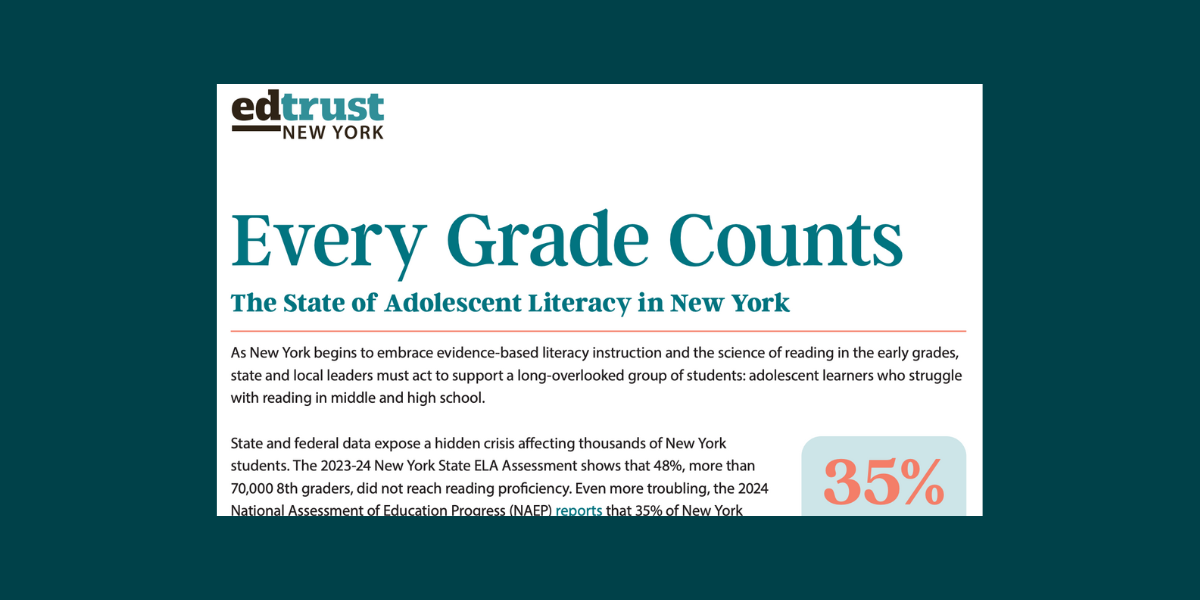
A recent report by The Education Trust–New York, Every Grade Counts: The State of Adolescent Literacy in New York, casts a stark light on a growing...

K-12Discover how Readable English is transforming reading instruction |
PROGRESS MONITORINGEasily assess and monitor growth with data-driven insights and reporting tools |
PROFESSIONAL SERVICESDiscover the services that support your success, from virtual training to expert coaching |
INDIVIDUALSStrengthen your reading skills with an interactive app tailored to your learning needs |
PARENTSEmpower your child's reading journey with an interactive app and expert strategies for home support |
|
|
Rethinking Reading: How One District Transformed Instruction (SmartBrief)Discover how a bold shift in reading instruction helped struggling learners thrive - and the critical role Readable English played in their success.
|
RESEARCH & RESULTSExplore peer-reviewed studies and real-world case studies on Readable English in action |
BLOGExplore articles on feature highlights, research deep-dives, and the latest literacy insights |
EBOOKDownload the ebook Why Learning to Read English is So Hard and how to Make it Easier |
CUSTOMER STORIESDiscover how educators and administrators are transforming literacy with Readable English |
RESOURCE AND PRODUCT ENABLEMENT LIBRARYFind essential educational references and instructional materials to enhance teaching |
FAQSFind essential educational references and instructional materials to enhance teaching |
NEWS & EVENTSStay up to date with media coverage, webinars, and upcoming events featuring Readable English |
|
|
Rethinking Reading: How One District Transformed Instruction (SmartBrief)Discover how a bold shift in reading instruction helped struggling learners thrive - and the critical role Readable English played in their success. |
9 min read
Tim Waldron
:
April 15, 2026
Reflections informed largely by the webinar on April 9, 2026, ‘Breaking Through: How Readable English Helps Multilingual Learners Cross the Decoding and Fluency Threshold with panelist Ashley Eichorn, Curriculum Coordinator at Norwich Public Schools (CT), Yadira Rojas-Reynolds,TOSA-ELD at Laguna Beach USD and hosted by Sabrina King, Customer Success Manager and former ML teacher.
There's a moment most multilingual learner teachers know by heart.
You scan the room. You're about to do a read-aloud activity. And you watch, almost in slow motion, as your students' shoulders tighten. Eyes drop. Some pull out a pencil and pretend to take notes. The bravest ones make eye contact and silently beg: Please don't call on me.
It's not apathy. It's not a learning disability. It's shame, shame rooted in a very rational fear of mispronouncing a word in a language that refuses to behave.
That fear has a name. It has a cause. And now, it has a solution.
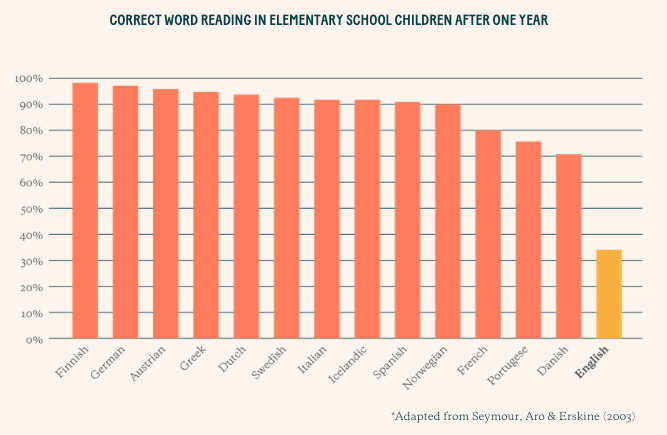
Here's a fact that should make every educator stop cold: after one full year of instruction, students learning phonetically consistent languages like Spanish or Finnish hit 90%+ word-reading accuracy. Students learning English? 35%.

Not 65%. Not 75%. Thirty-five percent.
That staggering gap, documented in Seymour, Aro & Erskine's landmark 2003 research. It isn't a fluke. English is genuinely one of the most orthographically opaque languages on earth. The same three letters can yield completely different sounds depending on... nothing you can reliably predict.
Consider: cove, love, move. Identical endings. Three entirely different vowel sounds. No rule explains it. No mnemonic helps. For a student raised on Spanish, Chinese, Russian, or virtually any other language, English reads less like a code and more like a cruel joke.
And we have been asking our most vulnerable students, newcomers, Long-Term English Learners (LTELs), multilingual learners in grades 4 and up to crack this joke with nothing but willpower and a phonics chart that quietly lies to them half the time.
During our recent webinar, I was struck by the story of Yadhira Rojas-Reynolds, ELD TOSA for Laguna Beach Unified School District. She, herself, is a former multilingual learner who arrived in the U.S. as a middle school newcomer. She was dropped straight into secondary academics with no foundational reading instruction to lean on.
"You will not catch me reading aloud in staff meetings," she told us recently in a webinar. "Because I feel the same way. I don't want to make a mistake."
She's a credentialed professional. And English spelling still rattles her confidence.
Now imagine what it feels like to be a 10th-grade newcomer in her district's high school. Sitting in a science class and expected to read a passage about cellular respiration. Unable to decode half the words on the page, and unable to ask for help out of shame.
This isn't a reading problem. It's a dignity problem.
Readable English doesn't replace the spelling of the English language. It doesn't dumb down the text. It doesn't ask your students to read baby books while their peers annotate grade-level articles. As Dr. Timothy Shanahan has stated, “Placing most kids in [easier] books provides no learning advantage, and often it has been found to be detrimental to learning... Those texts are opportunity deserts. Kids might accomplish the intended level of comprehension, but those texts afford kids little chance to increase or improve their reading ability."
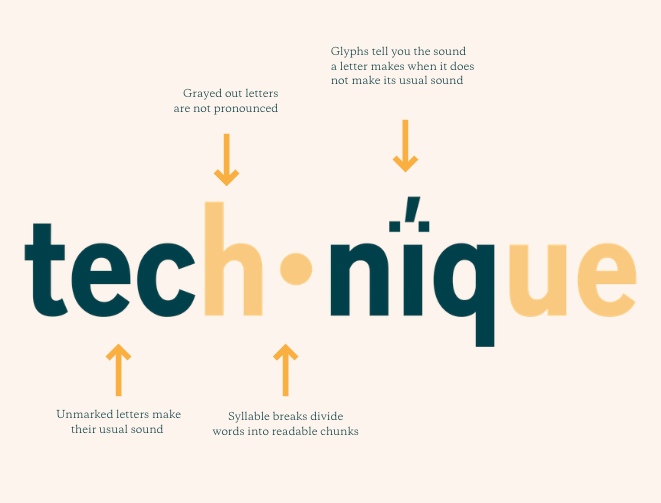
When we built Readable English, we wanted to create something elegantly simple: it makes English behave like a phonetic language, temporarily, by embedding a pronunciation guide directly into every word.

We built our markup system using diacritical marks because we wanted a way to make the invisible rules of English visible to every student. The same kind of accent and pronunciation guides that are used in dozens of other languages like French, Arabic or Vietnamese. For many ML students, this isn't foreign at all. It's familiar. Several Norwich Public School (CT) students, upon first seeing the glyphs, reportedly said: "Oh yeah, I've seen something like this before."
And most critically: the spelling is always kept intact. Students are learning to read real English, not a simplified approximation of it. They build the right neural pathways for the right words, so when the scaffolding eventually comes off, they're able to read the same text as everyone else.
Removing the guesswork when reading, also removes the potential for “fossilization”. This is a phenomenon in language acquisition where repeated use of an incorrect pronunciation becomes embedded in a learner’s interlanguage, making it difficult to change even with correction.
Traditional phonics instruction for older ML students often accelerates fossilization. Students encounter a word. They guess the pronunciation based on a rule that does not apply. The guess feels plausible. They repeat it. It sticks in the wrong way.
Readable English interrupts this cycle at the very first encounter. With the pronunciation guide, students are able to read the word correctly the first time. Their brain maps the correct sound to the correct letter pattern. No guesswork. No fossilization. No shame spirals two weeks later when a teacher gently corrects them in front of 28 peers.
"By taking the guesswork out," as Sabrina King, Readable English Customer Success Manager and former ML teacher, recently explained, "they get it [words] right the very first time and their brains can finally start mapping these words correctly, without the mental gymnastics."
46 multilingual learners, K–12. Languages include Russian, Chinese, Spanish, and Catalan. A significant cohort of high school newcomers arriving with no English reading foundation, placed directly into secondary academics.
Yadhira, ELA TOSA, shared during the webinar, that her district launched a four week summer pilot with a small group in 2025. As she shared, her first reaction was: "Glyphs? What is this?" following, almost immediately with: "This makes a lot of sense."
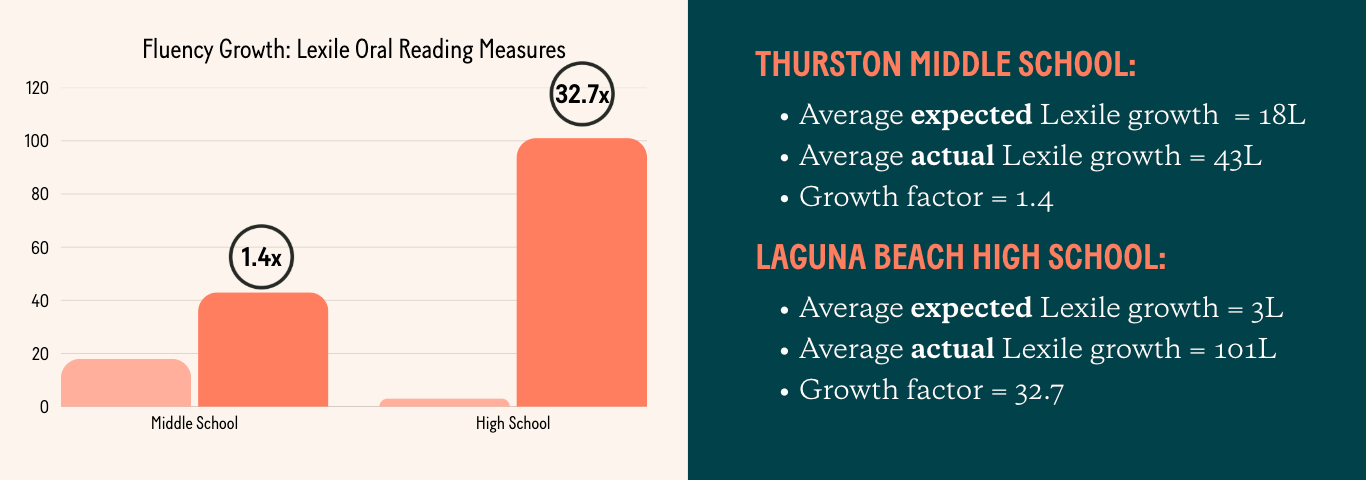
After implementing through the school year with both elementary and secondary students, the Lexile oral reading fluency data arrived:

That's not a typo. High school newcomers who were expected to grow 3 Lexile points grew 101 on average. In a single school year. Using the program about 30 minutes, three times a week.
One senior, on his way out the door, told Yadhira that when he first started learning the glyphs, he hadn't wanted to put in the work. Then he realized he'd been mispronouncing words for years.
"That," Yadhira said, "was a pretty cool reflection."
A K–8 district where 75% of students qualify for free or reduced lunch and over 30 languages are spoken. Approximately 825 identified multilingual learners. The district’s curriculum coordinator, Ashley Eichorn, described sending students to middle school "without the necessary reading skills", and was determined to stop.
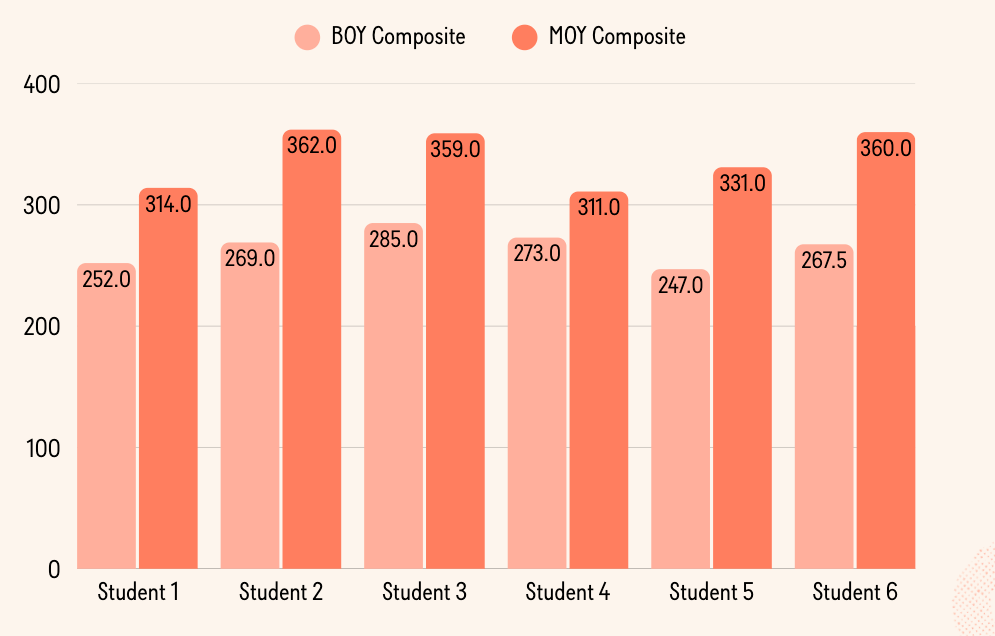
When Ashley first reached out to us she had learned about Readable English via a Natalie Wexler article she read in Forbes, How to Help Older Students that Struggle to Read. Implementation didn't really get underway for her and her team until the end of November, 2025. Two months post implementation she let us know that she pulled her first progress monitoring data. The data showed that her grade 5 ML students using Readable English were outpacing the growth of the total ELL population on both oral reading fluency and composite scores, even though every single one of those students had started the program below grade level, and below their ML peers.
The individual student composite score data showed approximately 28% total growth from beginning-of-year to mid-year. Every student. Every single one.

But the finding that stopped Ashley cold wasn't the scores themselves. It was this:
The school using Readable English became the only school in the district where ML students achieved the same growth rate as non-ML peers. In all six other elementary schools, ML students lagged behind. In this one school, after two months of using the mark-up, two months of daily 15-minute lessons, the gap had closed.
"72% of their MLL students and 72% of all students were making average, above average, or well above average growth. That was really exciting to see."
Test scores are compelling. They're also incomplete.
Both Yadhira and Ashley noticed something the Lexile reports don't capture: a shift in how students held themselves in class.
Ashley described students feeling empowered "because reading did start to become a little bit easier, even pretty quickly." Kids were going through the lessons not just because it was assigned, they were doing it because it made sense to them, because they were seeing results, because for maybe the first time, the English language was giving them information they could actually use.
And Yadhira told us about a 4th grader from her summer program.
The girl had learned the glyphs over the summer. When the school year started, she tracked Yadhira down. She wanted to know: when could she access the Readable Web extension? When could she get the RE mark-up applied to everything she was reading?
"We're talking about a fourth grader advocating for herself," Yadhira said. "That doesn't happen often."
No. It doesn't.
It happens when a student goes from struggling to survive to thriving, from keeping her head above water to actually diving into the curriculum. It happens when the tool meets the learner where they are instead of asking them to climb toward where the tool expects them to be.
Ashley's team wasn't immediately on board. Some teachers had strong mental models of what phonics instruction should look like. Glyphs didn't fit those models. There were conversations. A few of them were uncomfortable.
The breakthrough came when someone pointed out something simple: "Typical English rules aren't really rules at all. They're guidelines that don't always follow through." Meanwhile, a glyph is absolute. There's no question. There's no exception. It says exactly what sound the letter will make, every time.
Some ML students recognized diacritical marks immediately. They'd seen similar systems in their home languages. For them, the glyphs weren't weird. They were a logical extension of something familiar.
And once teachers started watching the light-bulb moments? Once they saw kids who'd been shut down for years suddenly reading, and wanting to keep reading? The conversations ended.
"Anything new always takes a little bit of time to adjust to," Ashley said. "But because it looks different and feels different, we have to make sure people understand why it's different and why that's okay."
I hear it all the time from administrators: 'We just don't have time for another program.' I get it, the school day is already packed. But when I look at the feedback from both Laguna Beach and Norwich, I see a different reality. They didn't find 'extra time'; they reclaimed the time they were already spending on ineffective interventions.
The question isn’t whether there is time for Readable English; it’s whether it’s acceptable to prevent students from accessing the texts their peers are already reading.
Here is what both districts actually reported:
"It's not meant to replace what you're already doing," Sabrina King explains. "Think of it as a turbo boost to your current curriculum."
Teachers don't need to learn a new instructional model. Students don't need to abandon their grade-level work and retreat to decodables. The program slots into existing class structures with, as Ashley put it, "minimal additional planning for teachers."
We have designed Readable English specifically for the students who are often left behind: multilingual learners, students with dyslexia, and those stuck in 'intervention cycles' that never seem to end.
This last group deserves particular attention. The overlap between "students who struggle with English orthography" and "students diagnosed with reading disabilities" is larger than most schools realize partly because the diagnostic tools weren't designed with ML students in mind, and partly because English itself is so difficult that a student without any disability can present with disability-like struggles.
Readable English doesn't diagnose; it intervenes, and does so in a way that has helped students once labeled and left to drift finally begin to make meaningful progress.
The data is in. Two districts, opposite coasts, different demographics, different entry points. The results rhyme.
Students are growing at rates that defy expectations. They're gaining confidence that doesn't show up in a Lexile score but shows up in raised hands and voluntary read-alouds and fourth graders advocating for their own access to tools.
The question as Sabrina King put it plainly at the close of the webinar: “its no longer a question of whether this works.”
The question is: how quickly can you get it to the students who need it?
Here's the most actionable advice we can offer.
If you're reading this in the spring, you have a window. Summer school. Extended programs. Transition weeks.
Identify your ML cohort now. Get them started on the glyphs before the school year ends, or over the summer. So that when they walk into their 5th grade classroom in September, or their 9th grade biology class, or their 11th grade AP History course, they're not starting from zero. They already have the code. They already know how English works.
Imagine your multilingual learners walking into class in August — already knowing the glyphs, already able to access content — no longer trying to just keep their heads above water.
That's what Yadhira did. That's why a 4th grader chased her down in September.
Ready to see it in action?
I invite you to book a demo with our team and we'll walk you through the program, show you the conversion technology, and help you identify which students in your district would benefit most.
The solution is here. Let's get it to your students.
→ Book a Demo at readablenglish.com
→ Request a link to the webinar by sending an email to info@readablenglish.com
Sources: Seymour, P.H.K., Aro, M. & Erskine, J.M. (2003). Foundation literacy acquisition in European orthographies. British Journal of Psychology, 94(2), 143–174. District data from Laguna Beach USD and Norwich Public Schools, 2024–2025 school year. Dr. Timothy Shanahan.https://www.shanahanonliteracy.com/blog/dont-confuse-reading-comprehension-and-learning-to-read-and-to-reread Natalie Wexler. https://www.forbes.com/sites/nataliewexler/2024/05/13/how-to-help-older-students-who-struggle-to-read/
A recent report by The Education Trust–New York, Every Grade Counts: The State of Adolescent Literacy in New York, casts a stark light on a growing...
Reading intervention for older students has long been one of the most challenging aspects of education. As highlighted in a recent article by The New...
In a recent article from Education Week, educators express growing concerns about older students still struggling with basic reading skills. These...